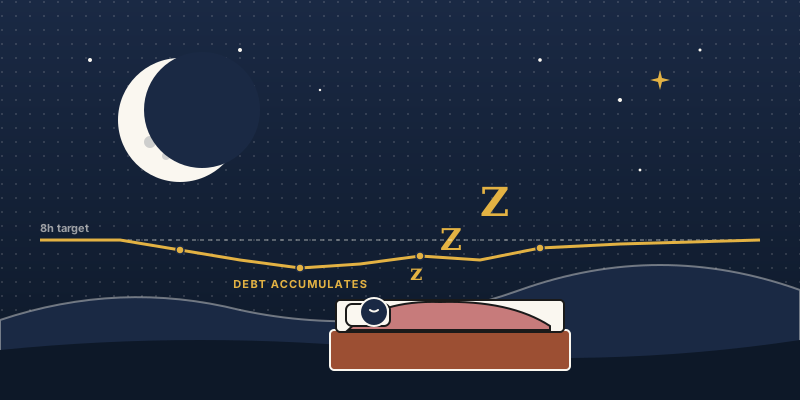
Sleep researchers used to think the brain "caught up" on sleep the same way you pay off a credit card: skip some, sleep extra later, balance restored. The last decade of research says that's only half right. Some of what sleep does for you snaps back within a night or two. Other parts — the parts that actually keep you functional — take far longer to recover, and a long weekend won't fix them.
If you've been telling yourself you'll "make up for it on Saturday," it's worth knowing exactly what does and doesn't recover.
What sleep debt actually is
The simplest definition: sleep debt is the cumulative gap between the sleep your body needs and what you actually got. If your target is 8 hours and you slept 6 last night, you accumulated 2 hours of debt. Sleep two hours less for five nights and you carry a 10-hour deficit into the weekend.
That arithmetic is fine as far as it goes. The problem is that the body doesn't repay sleep debt in a single ledger — it has at least three.
Three things deplete, three things recover at different speeds
1. Subjective sleepiness — recovers fast
How tired you feel is the dimension that recovers fastest. After one or two nights of recovery sleep, your self-reported alertness usually returns to baseline. This is what creates the dangerous illusion that you're "fine" after a weekend of catching up.
You feel rested. You're not actually rested.
2. Cognitive performance — recovers slowly
Sustained attention, reaction time, working memory, and decision-making lag well behind subjective recovery. A 2003 study (Van Dongen et al.) had participants sleep 4 or 6 hours a night for two weeks, then tested cognitive performance. Those getting 6 hours showed deficits equivalent to two nights of total sleep deprivation by the end — and they didn't notice. Their self-rated tiredness didn't reflect their actual performance.
Worse: after that two-week deficit, three nights of 8 hours did not restore cognitive performance to baseline. Recovery took roughly a week of consistent target sleep.
3. Metabolic and immune function — recovers slowest
Chronic sleep restriction disrupts insulin sensitivity, increases hunger hormones (ghrelin up, leptin down), elevates inflammatory markers, and weakens immune response. These systems normalize on weeks-to-months timescales — not days. A 2019 study in Current Biology found that two weekends of recovery sleep failed to reverse the metabolic damage caused by five nights of restricted sleep during the workweek.
So how much can a weekend actually fix?
Here's a reasonable rule of thumb based on the research:
- Under 5 hours of cumulative debt: a single weekend with two nights of 9-10 hours typically clears it.
- 5-10 hours of debt: a weekend helps subjectively, but you'll need a full week of consistent target sleep to restore cognitive performance.
- 10+ hours of debt over a sustained period: treat this as a multi-week project. Metabolic and immune effects may persist longer.
The asymmetry matters: it's much faster to accumulate debt than to pay it down. Five bad nights take far longer than five good nights to balance.
Why you can't just "sleep more on the weekend"
There are two practical reasons recovery sleep is limited:
Physical ceiling. Most adults cannot sleep more than 1-2 hours beyond their target on a recovery night. Sleep architecture self-limits — once the body has cycled through enough deep and REM sleep for its needs, you wake up. Trying to sleep 12 hours after a week of 5-hour nights generally produces 9 hours of sleep plus 3 hours of lying in bed.
Circadian disruption. Drastic weekend bedtimes shift your circadian phase. Friday and Saturday at 2 AM, then Sunday night trying to fall asleep at 10 PM — that's a 4-hour phase shift, the equivalent of flying to a new time zone. Monday feels awful, partly because you have circadian misalignment on top of any remaining sleep debt.
What actually works
Don't accumulate the debt in the first place
This sounds glib, but it's the only intervention that produces compounding returns. A consistent 7.5-hour schedule beats a chaotic 8-hour-average. Sleep is a daily metabolic function, not a weekly one.
Anchor the morning, not the bedtime
Consistent wake time is the strongest signal to your circadian system. If you're forced to choose, keep wake time fixed and let bedtime drift slightly.
Treat recovery as multi-day, not single-night
If you do accumulate debt, plan a stretch of consistent target sleep — 5-7 nights minimum. A single 11-hour Saturday won't fix a week of 5-hour nights.
Watch caffeine timing
Caffeine's half-life is roughly 5 hours, but its effect on sleep can persist 8-10 hours. A 4 PM coffee can fragment sleep at midnight without you noticing. If you're trying to pay down debt, move the cutoff earlier.
The honest framing
"Catch-up sleep" is real, but it's not a free refund. Subjective tiredness comes back fast; cognitive performance lags; metabolic effects lag further. The cumulative impact of chronic short sleep — even just an hour or two below your target consistently — is the part that most people don't notice and that the calculator in our sleep tools can make visible.
Tracking your nightly hours for a week is the easiest way to see whether you're carrying debt you've stopped feeling.