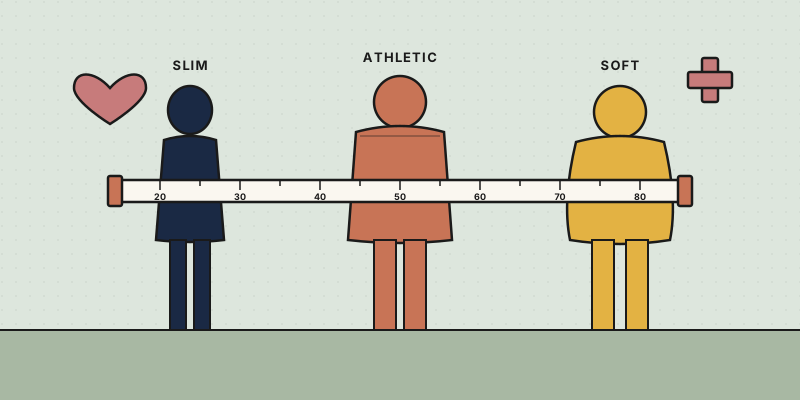
BMI is everywhere — on doctor forms, insurance applications, school physicals, fitness apps. It's also one of the most aggressively misunderstood numbers in everyday health. A 5'10" defensive end with 12% body fat and 230 pounds of muscle reads "obese" on a BMI chart. A 5'10" sedentary office worker with 28% body fat at 165 pounds reads "normal." Both numbers are mathematically correct. Neither is medically useful in isolation.
The problem isn't that BMI is wrong. It's that BMI was never designed to do the job we keep assigning it.
What BMI actually is
BMI is mass divided by height squared. It was developed by a Belgian statistician in the 1830s — Adolphe Quetelet — as a way to describe populations, not individuals. Quetelet's stated goal was to find a formula that correlated with body size across large groups, useful for actuaries and demographers. He explicitly did not intend it as a diagnostic tool for any single person.
A century and a half later, it became a diagnostic tool for every single person. The math hasn't changed; the use has.
What BMI is good at
To be fair to BMI: it's cheap, fast, and population-scale useful. At the level of "what is the obesity rate in this country?" BMI gives a defensible answer because the muscular outliers and the high-body-fat outliers approximately cancel out in large samples. Public health researchers genuinely need a metric like this and BMI fills the role.
For epidemiology, BMI is fine. For population-level screening, BMI is fine. For predicting your individual cardiovascular risk, your metabolic health, or whether you should be losing weight? It's a coarse proxy at best, and frequently wrong.
The four failures of individual BMI
1. It cannot distinguish muscle from fat
Two people of identical height and weight have the same BMI. One could have 15% body fat (athletic) and the other 35% (high cardiovascular risk). BMI sees them as identical.
This isn't a niche issue. Roughly a third of American adults classified as "overweight" by BMI are metabolically healthy by every other measure. Conversely, a meaningful fraction of people with "normal" BMI have visceral adiposity that puts them at elevated cardiovascular risk — they look fine and the number says fine, but the underlying health picture is not.
2. It doesn't measure fat distribution
Where you carry fat matters more than how much you carry. Visceral fat (around organs, abdomen) carries dramatically higher metabolic risk than subcutaneous fat (under the skin, hips and thighs). Two people with the same BMI and the same body fat percentage can have very different health outcomes depending on distribution.
This is why waist-to-hip ratio and waist-to-height ratio are better predictors of cardiovascular risk than BMI for most adults. A waist circumference greater than half your height is a reasonable, simple flag — and BMI completely misses it.
3. It systematically misclassifies people at the extremes
- Athletes with high lean mass routinely score "overweight" or "obese" despite low body fat.
- Older adults who have lost muscle but gained fat ("sarcopenic obesity") can score "normal" BMI while having dangerous body composition.
- Short or tall people at the extremes get awkward results — the formula squares height, which works decently in the middle of the height range and increasingly poorly at the tails.
- Different ethnic populations have different body composition norms at the same BMI. South Asian populations, for example, develop metabolic risk at lower BMI thresholds than European populations.
4. It says nothing about trajectory
A BMI of 27 going up is a different situation than a BMI of 27 going down. The number is the same; the meaning is opposite. Single-point measurements ignore the direction of travel.
What to use instead (or alongside)
Better individual measures, in roughly increasing order of accuracy:
Waist-to-height ratio
Measure waist circumference at the navel, divide by height in the same units. Under 0.5 is considered healthy for most adults. This catches central adiposity that BMI misses, requires only a tape measure, and is the easiest upgrade if you want a single number better than BMI.
Body shape (A Body Shape Index, BAI, ABSI)
These newer metrics combine waist, hip, height, and weight to capture body shape rather than just mass. They correlate better with mortality risk than BMI in most studies. A bit more arithmetic, but worth knowing.
Body composition (DEXA, BIA, skinfolds)
Direct measurement of fat vs lean mass. DEXA scans are the gold standard but cost $50-150 per scan. Bioelectrical impedance (BIA) is cheaper, less accurate, but useful for tracking trends. Skinfold calipers are old-school but surprisingly reliable in trained hands.
Metabolic markers
Fasting glucose, HbA1c, lipid panel, blood pressure. These directly measure the things that BMI is a (weak) proxy for. If you have access to bloodwork, the metabolic panel tells you far more than any anthropometric measure.
So should you ignore BMI?
Not exactly. BMI is fine as a coarse, free screening tool. A BMI of 35 in a non-athlete is genuinely informative — it's very unlikely that mass came from muscle. A BMI of 22 in someone with a 38-inch waist tells you central adiposity is present despite normal weight.
Use BMI as one signal. Combine it with waist-to-height ratio. Track trends rather than single points. And ignore the chart-based judgment about "your category" — your individual health picture isn't decided by a number designed for actuarial tables.
If you want to see how your numbers look across multiple metrics — BMI, body shape, body fat estimate, waist-to-height — running the relevant calculators side by side gives a much clearer picture than any single one alone.