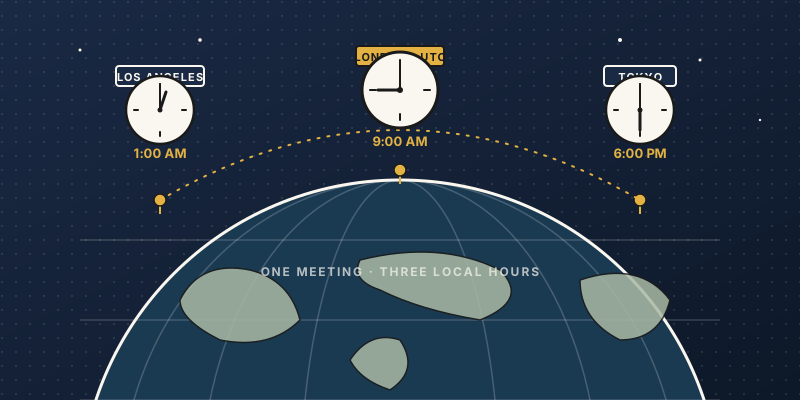
Every distributed team eventually hits the same wall. Someone in San Francisco proposes a 9 AM weekly standup. The Singapore engineer politely points out that's 1 AM her time. The London product manager suggests 4 PM Pacific instead. The Singapore engineer notes that's 8 AM Sunday morning in her time zone. Everyone shrugs, picks an option, and one person ends up taking the meeting from bed every week for the next year.
This pattern isn't a scheduling problem. It's a fairness problem disguised as one.
The trap of averaging
The most common mistake teams make when scheduling across time zones is using average convenience as the optimization target. "If we pick 4 PM Pacific, the average local time across the team is 9 AM, which is reasonable!" the lead reasons. And technically the average is reasonable. But averages hide outliers.
A meeting that scores 1.0 (perfect business hours) for three people in California and 0.0 (middle of the night) for one person in Tokyo averages to 0.75 — sounds great. But it's still the middle of the night for that one person, every single week. The average makes the math look fair. The lived experience is not.
The minimum-score principle
A better optimization target is the score of the worst-off participant. Instead of asking "what's the average convenience?", ask "what's the convenience for the person this meeting hurts most?"
This single change reframes scheduling. A 4 PM Pacific meeting suddenly fails the test — Tokyo's score is 0, so the meeting score is 0. The meeting may still happen, but the team now knows what they're asking and from whom.
When no fair time exists
For teams spanning 12+ hours (e.g., West Coast US ↔ East Asia), there often is no time that scores well for everyone. Three things to do:
1. Rotate the cost
Pick the top-scoring time this week. Next week, pick the second-best. The week after, third. The unpleasant burden moves around the team instead of permanently landing on one person. Document it explicitly so nobody feels singled out.
2. Split the meeting
Run two adjacent regional sessions with overlapping representation. Record both. The cost in coordination is real, but smaller than burning out your most distant colleague.
3. Default to async
The honest question is whether the meeting needs to be synchronous at all. Most recurring "status" meetings can become written async updates plus a 15-minute Q&A held at the best time available. The synchronous time should be reserved for things that genuinely require live discussion — typically decision-making, conflict resolution, and relationship building.
Scoring time fairly
What does a "fair" score look like in practice? A reasonable framework:
- 1.0 — core hours (9 AM to 5 PM local). Anyone can meet here without disruption to their day.
- 0.7 — edge hours (8 AM or 6 PM). Workable but loses the buffer for overruns or commutes.
- 0.4 — early evening / very early morning. Possible but actively cuts into personal time.
- 0.0 — middle of the night. Schedule this only with consent and rotation.
You can adjust the bands for your team, but the principle stays: the score should drop sharply when you cross into someone's personal hours. Smooth gradients hide the asymmetry the minimum-score principle is trying to expose.
Daylight saving complicates everything
Two facts to internalize:
- The US/EU DST shifts are not synchronized. There's a 2-3 week window every spring and fall when "the same meeting time" means a different local time in different countries.
- Several major regions (most of Asia, much of South America) don't observe DST at all. Their gap to DST-observing partners shifts by an hour twice a year.
If you schedule recurring meetings, plan to revisit them at every DST transition. What was a 5/10 meeting in November may become a 2/10 meeting in March.
One more cost teams underestimate
The standing 10 PM call for the Tokyo engineer isn't just inconvenient. It's a tax on her ability to be present in the rest of her evening, exercise, see family, sleep on a normal schedule, and maintain energy for the rest of her work the next day. Multiplied over 50 weeks, it's a significant invisible compensation gap between her and the colleagues who never take meetings outside business hours.
Teams that don't model this invisible cost end up with attrition from their most-distant employees and never quite figure out why. Modeling it explicitly — through a minimum-score scheduling rule, through rotation, through async-by-default — is one of the cheapest things a distributed team can do to retain its people.