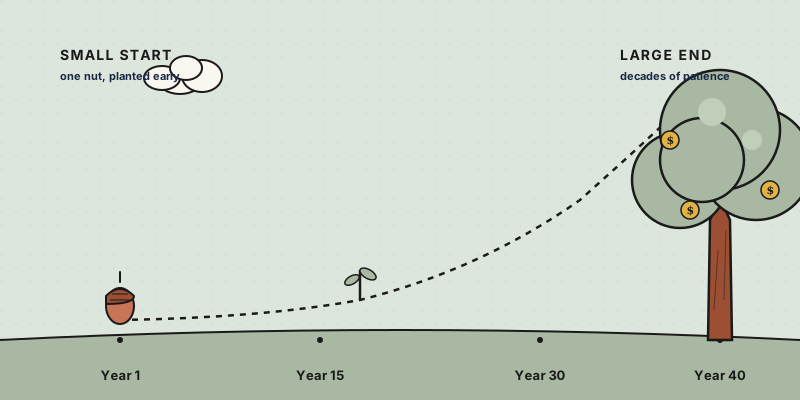
If you've ever sat through a finance lesson, you've heard the line: "compound interest is the eighth wonder of the world." You've probably nodded along, run a calculator, seen the big future number, and then quietly gone back to spending the savings rate you had before. The problem isn't that compound interest is over-hyped. It's that the way most people picture it, in their head, is wrong — and the wrong picture leads to wrong decisions.
The mental image most people have of compound interest is a slope: a steady, encouraging climb. The actual shape is a J — almost flat for years, then suddenly steep. And the gap between those two pictures is responsible for a lot of bad savings decisions.
What "compounding" actually does
The simple version: each year, you earn interest on your principal and on the interest from previous years. That second part is what gets called "interest on interest." It sounds modest, and for a while, it is. Then it isn't.
Take $10,000 invested at 7% annual return. Here's what happens, year by year:
| Year | Balance | Annual gain | Cumulative gain |
|---|---|---|---|
| 0 | $10,000 | — | $0 |
| 5 | $14,026 | $918 | $4,026 |
| 10 | $19,672 | $1,287 | $9,672 |
| 20 | $38,697 | $2,532 | $28,697 |
| 30 | $76,123 | $4,980 | $66,123 |
| 40 | $149,745 | $9,801 | $139,745 |
Year 5: the account is up $4,026. Encouraging, but not life-changing. Year 10: up $9,672. Year 20: up $28,697. Year 30 alone added $37,426 — more than the total gain in the first ten years combined. Year 40 alone added $73,622.
That's the J-curve. The first decade looks like nothing is happening. Then the curve bends.
Why "start early" matters so much
The standard advice is to start saving young. The reason this matters isn't moral; it's mathematical. Compound returns produce most of their value at the end of the runway, not the beginning. Cutting the runway short doesn't just remove a few years — it removes the years that mattered most.
Consider two savers:
- Alice saves $5,000/year from age 25 to 35 — ten years, $50,000 total contributions — then stops, and lets it grow until 65.
- Bob saves $5,000/year from age 35 to 65 — thirty years, $150,000 total contributions.
Both earn 7%. Who has more at 65?
Alice has roughly $602,000. Bob has roughly $510,000. Alice contributed one-third as much money, stopped 30 years early, and still ended up with more.
This is the part that doesn't survive in the mental model of "compound interest = good." The intuition is that more contributions over more time produces more money. The math says: time on the curve matters more than total contributions, especially at the steep end.
The two visualizations that change behavior
If you've struggled to internalize compound growth, two pictures help.
1. The doubling time
The Rule of 72: divide 72 by your annual return percentage to get the number of years it takes to double. At 7%, money doubles every ~10 years. So $10,000 today becomes:
- $20,000 in 10 years
- $40,000 in 20 years
- $80,000 in 30 years
- $160,000 in 40 years
The last doubling — the jump from $80k to $160k — is bigger in dollar terms than the first three combined. That's the J in action.
2. The "cost" of skipping a decade
Whatever your current portfolio is, a decade of growth at 7% roughly doubles it. Asking "what would I do with 2x my current net worth?" is a more visceral way to picture what you're trading off when you delay saving by ten years.
What this means for behavior
Three concrete implications:
Get started now even if the amount is small
The compounding benefit comes from being on the curve, not from being far along it. A 25-year-old saving $100/month beats a 35-year-old saving $300/month, in the long run, because the smaller contribution gets ten more years of compounding.
Don't pull money out early without doing the math
Borrowing $20,000 from a retirement account 30 years before retirement isn't a $20,000 decision. It's roughly an $80,000 decision, because that money would have doubled three times. The opportunity cost is the steep end of the curve you're forfeiting.
Stop checking the balance constantly
The early years feel slow because they are slow. The discouragement of watching a small balance grow by small amounts is one of the main reasons people give up on long-horizon investing. The math rewards patience, not vigilance.
The compounding nobody talks about
Compounding works on more than money. Skills, relationships, health, and writing all behave like compound interest — small consistent deposits, almost no visible progress, then sudden non-linear gains years later. The shape is the same. The right response is the same: start early, contribute consistently, trust the curve before you can see it bending.
If you're trying to model what compound growth looks like for your specific savings rate and time horizon, the compound interest calculator can plot the J-curve for any inputs.